Home Blog Page 17

Brand Strategy With A Limited Menu.

0

There is a West coast brand consultant I came across yesterday who does much the same things as I. From the screen grab below you will see the offerings are quite varied. There are 20 bullets. Very comprehensive. VEry impressive.
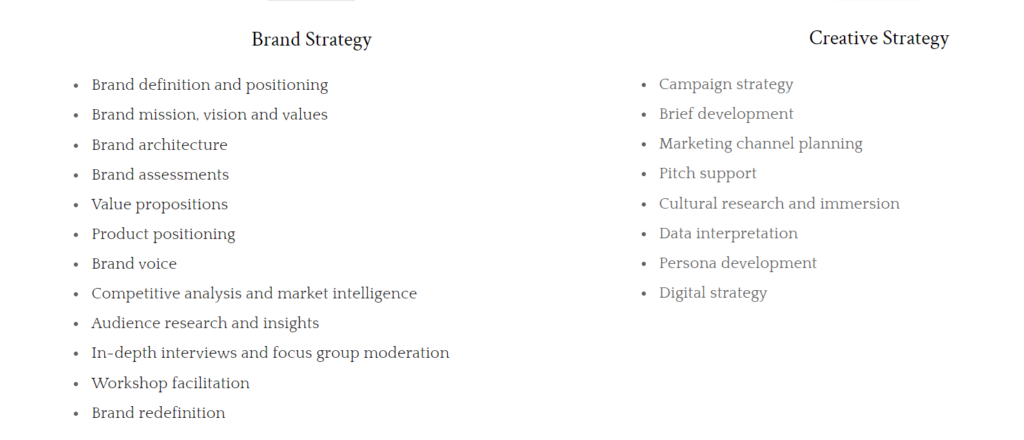
 

What’s The Idea? has 2 bullets. Only two offerings.  A brand brief and a one-page brand strategy. Those are my wares.

The brand brief is the tool I used to create the one-page brand strategy. The strategy contains a “Claim” and three “Proof Planks.”  Proof planks are discrete value headings, inherently tied to brand success. All interlock with the Claim. For a client in the commercial maintenance business we used the Claim the “Navy Seals of Commercial Maintenance.” The proof planks are “fast,” “fastidious” and “preemptive.”  Under each plank resides a list of individual proof points. An actual example or demonstration of value.  Not a platitude or generic, baseless claim, but a scientific, existential act, deed or accomplishment. People remember proof, they do not remember marketing fluff.

In brand strategy, proofs often become the subjects of ads, events or other content.

With all deference to other brand strategy consultants with menus, I give you a simple offering: an organizing principle for product, experience and messaging. I give you a brand brief and a brand strategy – the foundation for all things marketing. The strategy drives campaigns and voice and personality but does not dictate them.  That’s the job of the agency.

Simple is complex sometimes.

Peace.

 

Think Before You Type. People Are Listening.

0

Any copywriter will tell you words are important.  Of course, they will.  But how many will dig deeply enough to find the right words that connect with the target. That demonstrate to a target they understand, sympathize, empathize and gets the reader?  Words can be found in a dictionary.  AI copy is not that far away, if it is not here already. Auto AdWords anyone? Good copy is personal.

I heard something on NPR this morning that struck me as a great example of words versus copy.  The story was about the shooting of Jayland Walker, a black man, in Akron, OH and this was the lede: “One in one thousand black men in America can expect to be shot by a police officer.” It’s a real smack in the face line of copy — but it must have been written by a white person because it is utterly untrue. I’d say nearly all black men in America worry about being shot by a police officer. Not one in a thousand. Parse the sentence and it may have been accurate — statistically one in one thousand black men may be shot by police. But that’s not what a black man is likely to hear.

We have to listen to our words. We have to try to contextualize our words.  That shit isn’t woke. It’s listening and thinking. Think before you type.

Rest In Peace Jayland Walker.


Brand Roots.

0

A brand strategy is only as strong as its roots.  I’m in the roots business. With roots in place, it is then up to the CEO, CMO, director of marketing and brand managers to do the cultivation work.  Otherwise, a brand strategy is a piece of paper and a bunch of words contribution to the pantheon of marko-babble — no more important than a shareholder letter, an about section on the web, or ad in a charity program.

Roots are where growth comes from.  And I’m not talking about sales growth, I’m talking about strategy and tactical growth. You see, tactics today comprise 85% of marketing budgets. Check your marketing budget. And tactics are what we measure for sales effectiveness. But tactics sans brand strategy (the organizing principle for product, experience and messaging) do not grow into healthy trees.  When a brand strategy is managed well, everyone at a company is looking for ways to prove the strategy.

When working at McCann-Erickson NY on AT&T, I sent a brand idea to our CEO John Dooner. It was an idea for a demonstration of “refreshment,” the Coke brand idea. It may have been one of the most brazen things I had ever done. I didn’t send an idea to do more advertising, I sent an idea to support the brand claim.

Coke had great roots. People knew how to feed them.

Peace.


The Science of Brand Purchase.

Asking people if they will buy a product is a form of quantitative marketing research. It’s directional but flawed.

We launched a web page development product in 2007 that quantitative research told us was something people would use like crazy. The functionality of the tool: uploading pictures, video, audio, original text and other digital objects, like Facebook and MySpace yet without the restrictions of a design template, was universally desired. Projections were for 60% adoption of adult targets. On paper.

When the product launched, usability was poor. Not intuitive to the non-techie prospect. The startup failed — even though the research suggested otherwise.

Asking people why they bought a product after purchase is a more accurate form of market research. And a better predictor of future results. But for startups it becomes a chicken and egg thing.

When a brand strategy client is having a poor sales swing, it’s my job to understand why. It’s my job to get inside consumer heads and reason out the buy/no buy behaviors. In my world – the brand strategy world – I look for the three most important reasons a person prefers a product, typically found among customer care-abouts and brand good-ats.  Then I package those three things under brand claim closely tethered to the three benefits. This becomes the organizing principle for product, experience and messaging aka the brand strategy.

This organizing principle becomes the science of purchase upon which to build quantitative research. That’s the chicken. Quantitative research sans strategy is science without a hypothesis.

Peace.   


How Brand Strategy Works.

0

I worked at an ad agency a while back that did the advertising for the North Shore-LIJ Health System, now known as Northwell Health. The brand strategy for the work used the word “systematized” as part of the claim — a word some of senior hospital management people felt was cold and impersonal.  It was the job of the creative team to warm up the claim, but there was no denying North Shore was a system and that constant measurement and improvement was their secret sauce. Still is.

Anyway, no matter who I met with at the system, no matter the clinical practice, the way to the particular ad topic was through a discussion of the systematized way the group improved care. No sidebars about how much they “cared” or deep dives into what they called “the highest quality of care,” we hunkered down in the measures and processes and, hopefully, unique practices. You see the tagline for the system was “Setting New Standards in Healthcare” and for every ad that was our mission — always show the standards and practices North Shore used to improve care.

Having that brand strategy in place made our job easy.  It made the jobs easier for the doctors, nurses and administrators we interviewed. In fact, over time they would know the questions we would ask, before we asked them.  A great brand strategy is enculturated into an organization. Same hymnal, same pew.

For examples of how this enculturation works in other categories, write Steve at WhatsTheIdea dot com

Peace.    


One That Got Away.

0

Newsday is a New York regional newspaper.  It serves Long Island, home to 3.5 million people. Newsday also has distribution in Queens. At one time it was one of the top 10 circulating newspapers in the country.

The ad agency I worked for on Long Island, Welch Nehlen Groome, handled the Newsday account, doing periodic TV commercials. Mainly promotional and project work.  One of the problems selling newspaper on LI was that it was a commuter island. Most of the heavy hitter worked in the city. And those people read the NY Post and NY Daily News on the train on the way home. These were NY city-based papers with sensational headlines and great sports sections. The New York Times and Wall Street Journal were big morning reads, filled with business and national news.  Not a lot of space in between for a paper covering Long Island news, e.g., “Blue Angels to Appear at Jones Beach July 4th”.

Much of Newsday’s circulation was home delivery; people who wanted Wednesday food ads and some local high school sports coverage.

I wrote a brand strategy for Newsday, the claim for which was “We know where you live.” It was a plea to commuters, whose jobs were in the city and who lived on trains, to get back closer to their families and neighborhoods — but it also reinforcement to non-commuters and homebodies, the position that the paper as better attuned with their lives and lifestyles.

Cool freaking idea. Tagline worthy I thought.  Someone at Newsday co-opted the claim to read “It’s Where You Live,” which was used as a tagline and lived for years. Unfortunately, it removed Newsday from the equation, a no-no. And it could have been interpreted as a simple usage claim. We know where you live, some decision-makers thought, was a little intrusive and perhaps anti-privacy.  Huge client mistake in my opinion. It gutted the strategy.

If adopted as a tagline, “We know where you live” could still be in place. A working claim and a working strategy. And strategies rule the tactical world.

One day I’ll tell you about my other Newsday idea to shut down the Long Island Expressway and throw the world’s biggest block party.

Peace.


Love. It’s What Makes a Brand Plan a Brand Plan.

0

On my website and bio I let everyone know about the high-profile brands I have worked on: Microsoft, JP Morgan Chase, Abbott Nutrition, Northwell Health, Pricewaterhouse Coopers, ConAgra, Newsday and Sunkist.  But that’s me showing off. 

A lot of the work I’ve done and enjoyed has been for lesser-known brands: Excel Commercial Maintenance, Sweet Loren’s, Biz2Credit, Trail of Bits, Handcraft Manufacturing, and pro-bono Appalachian Specialty Pharmacy to name a few.  I’ve written before that a brand planner has to fall in love with the brands s/he works on…and it’s true.

You don’t set out to love them but it just comes naturally. The more you know the more you warm up.  Knowing you are searching for ways to shed them in the most positive light helps. That’s not to say you overlook any shortcomings or negatives but it’s our job to accentuate the positive. And that becomes easier as you grow more acclimated and more predisposed. Love may sound a little over-the-top, but it’s not. It comes with time and effort.

Sometimes the smaller brands are easier to love. They come with less baggage. Less complication. It’s all good. They are all fun. Love is love.

Peace.


Discovery Is Not Rediscovery.

It’s easy to say “dump the cache” when approaching every new brand strategy assignment — as in, approach it anew, without any preexisting opinions formed — but let’s be realistic, our brains are filled with information. It isn’t easy.

The elixir to my discovery is the customer and prospect interview. I ask questions. I listen. I interrupt, with a healthy interest in what is being said. Not rudely, excitedly.  I reshare stories from my life so they know it’s a conversation (don’t tell my Rollins anthropology professor, she’d shit.) The point is, it’s only by digging into each new interview that I can flush the detritus from earlier references and focus in on a new brand.  (After discovery, when sleeping and cogitating about claim and proofs, old info may come into play. But that’s subconscious stuff and fair game.)

Every brand is and must be viewed anew. Every brand is and must be a treated and seen, not as a different flavor, but as its own unique entity. Pure. As. The. Driven. Snow.

Peace.


Last Touch.

0

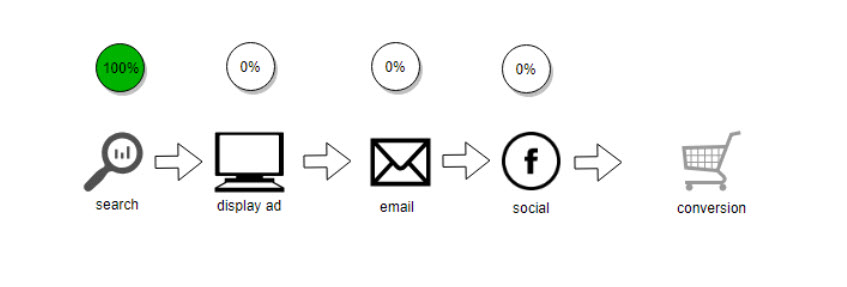
I’ve been learning a lot lately about marketing technology.  It’s fascinating and scary. I recently had a lesson on the digital metric “last touch” before a sale. The lead attributed to the platform where a “conversion” (sale) was made. The cool thing about this metric is it acknowledges there is a continuum of touches leading up to a sale.

This is great for ecommerce plays but gets a little hinky for retail. A decade or so ago, I came up with a customer journey-esque rigor I called Twitch Point Planning.  A Twitch being a media move from one platform or device to another. An example would be a Twitch from an Inc. Magazine story on the tech scene in Asheville, to a Google search for “Asheville Technology Companies.” This Twitch could happen all on an iPhone or if could take place while listening to NPR in the car, followed by a Twitch to a mobile phone search. Twitches are serial touches. And hopefully trackable.

The goal of Twitch Point Planning is to move a customer closer to a sale.  In other words, we are not just focusing on the last touch, but on all touches in the queue. We are good with last touch but not so much the serial bread crumb trail. Modeling the rest of the funnel is what martech (marketing technology) is all about.

The fact that we are talking about it is exciting. The fact that some companies are investing 90% of their marketing budgets on the last touch (Google/Facebook), though, is startlingly shortsighted.

Peace.


The Brand Strategy Blur.

When I try to explain to businesspeople what brand strategy is, I end up using words like “framework” and “organizing principle.” But these words are rather formulaic and scientific.  I mean, what business doesn’t have a framework or organizing principle? So when the polite nods are done I tend to jump to the end-benefit. Recently, while explaining what I do to a graphic designer I tried to tailor it to his frame of reference saying “A brand strategy is the words a graphic designer needed to know what to design.”  For a copywriter “a brand strategy explains what the goal and content areas are of the writing.”  Again, a little structural, not so much benefit-oriented. So, I cleaned it up by saying “a brand strategy gives you direction, saves you time, and reduces wasted creative hours.” All of which save money.

The problem with that benefit is since of the advent of the railroad, the automobile and machines, saving time and money has been an oft-cited end-benefit. Having grown up in the IT (information technology) age, working on many tech brands, I can tell you efficiency, and money saving have been the end-benefit of 80% of ad strategies. Some implicit, most explicit.

How, then, do I talk about the benefits of brand strategy in a breakthrough way? I’ve been pondering doing so with a person-to-person or person-to-group workshop.  One in which I demonstrate the framework, interactively rather than theorize it.

Tune in tomorrow for more.

Peace.