Home Blog Page 21

Taglines Gone Wild.

0

The tagline is a very misunderstood communications and branding device.  A tagline should be the de facto brand claim.  Beside the product itself, it is the single most important thing consumers should remember about your offering.  While a brand strategy is actually one claim and three proof planks, the claim element is the one indelible thought or value that motivates preference, consumption and repeat consumption.  I would say loyalty, but one can be loyal and not consume.

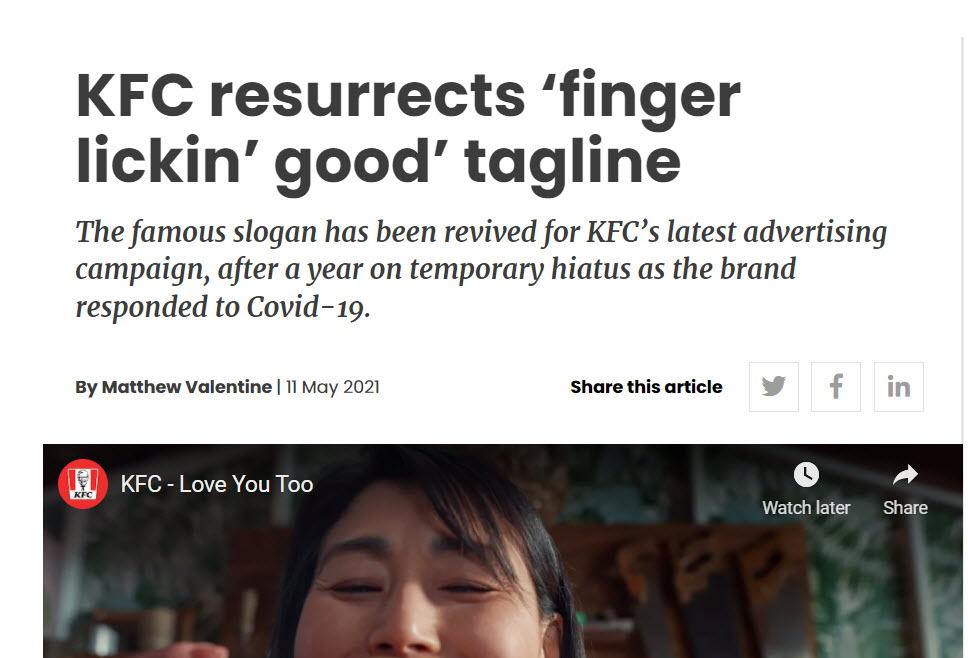
Many marketers go wrong when they confuse branding with advertising. This happens when the advertising campaign line or tagline drives branding. KFC’s “Finger Lickin’ Good” is a great example an advertising tagline that brilliantly reflects the brand claim. “That’s My Mission,” the tagline for Mission Health, is way too ad driven — and not even close to a meaningful, powerful brand claim.

Unless your tagline can reflect a coherent, endemic brand value, you are wasting branding dollars. And ad dollars.

Brand strategy first then advertising. Not the other way around.

Peace.


Implicit versus Explicit Brand Claims.

0

I came across this testimonial statement on LinkedIn by cyber security firm Delinea. It was posted by Interbrand, their branding company. The work followed the merger of two companies into one.

The Interbrand team worked collaboratively with us to crystalize our unique points of differentiation and capture our essence. With their guidance, we built Delinea into a stand-out brand in our industry, with a clear ambition and a purpose that guides our decision making.”  Art Gillilan, CEO, Delinea

Two quick observations:

  1. I’m not sure I agree brand strategy should encompass “a clear ambition.” When it does it often uses language like “industry leader.” “purpose,” or “intention.” That’s me focused not you focused. Company-centric not consumer-centric. The best brand claims focus on the buyer.
  2. I love that the brand strategy guides company decision-making. Brand strategy must do that. It saves money. Multiplies the value. And creates culture.

The proof of a good brand strategy however is in the pudding, and this is how the website describes Delinea. I call it the Is-Does.

Delinea is a Privileged Access Management Leader Providing Seamless Security for Modern, Hybrid Enterprises.

The only word of value in this statement (to business buyers and security engineers) is seamless. And while the Delinea name suggests seamless (a good thing), I’m not sure as a benefit it hits the mark powerfully enough. Seamless, as a brand claim, implies a benefit. They could have been a quite a bit more explicit in their positioning.

Peace.


Brand Strategist as Navel Gazer.

0

I have a client who is a savvy, savvy marketer in a high growth business. He really gets my brand strategy framework. His is a complicated business, not easily explained to people outside the technical category.  One of the things this CEO likes about my work is that I do lots of interviews with employees and customers but also outside SMEs (subject matter experts) to help with balance.

The client takes my rough transcript notes from the employee and customer interviews and scours them, using the verbatims to stay in touch with their feelings about the company. So, while I’m extrapolating and packaging brand strategy, he’s using the notes as a kind of satisfaction research. I suspect the interviews fill in some holes not otherwise found through face-to-face meetings, tech blogs and business presentations.

(Andy Grove, CEO of Intel way back when, started each day listening to the customer care hotline. It was his way of staying on top of things.)

I wonder is these interviews of mine may be a more in-demand revenue stream for What’s The Idea? than is “brand strategy.”  Not a lot of C-level executive wake up in the morning saying “I need a brand strategy.” But many wake up wondering what their customers and employees think.

Hmmm.

Peace.


Branding Is Multiplex.

0

Brand strategy is all about immersion in your product or service. Identifying problems and clarifying opportunities. You can spend scores of hours listening to consumers talk about your product and watching them use it. You can talk to the sellers of the product, the makers of the product, and the engineers. After many hours you begin to see patterns and reoccurrences of values. It helps form your plan. The plan to position your product.

Don’t forget, though, that your brand isn’t an island. It operates in a competitive arena. And there are people loving, liking, using and recommending competitors. It’s not good enough to look at the competition’s website and come to conclusions about its value. You need to do immersion there as well.  You need to pry into the psyches of consumers you want to win over. You need to see how tightly consumers embrace your competitors. They have a job to do and they, presumably, are working hard every day to defend their share.

So, it’s not just about finding the optimal spot to position your product, it’s also about examining consumer predilections for your competitors. Branding is not binary, it’s a multiplex.

Peace.


When Does A Name Become A Brand?

0

What’s The Idea? is a brand strategy consultancy.  I used to say brand consultancy but for many that’s misleading.  The masses believe brand to be name and logo. Nouns. My business treats brand as an action verb. To brand is to create pointed value. One overarching value, supported by 3 unique and extremely well-defined areas of proof.  Alone, these proof areas may not be unique.  Together, and organized beneath the brand value (claim), they are highly strategic. And scientifically proven to be business-winning.

Nine out of ten brands are so in name only. Faux brands. A mid-size company will spend $12,000 on an artistic sign before spending a dollar on brand strategy. That same company will pay web developers $40,000 to redesign their website yet only $1,000 on the written content – sans strategic direction.

Large corporations with marketing departments and 6 or 7 figure budgets all talk brand.  And occasionally use it as a verb.  But ask them to drill down to the real brand strategy framework, the exact and specific values, and their tongues are tied. They use the word almost as magic, hoping upper management will let them be.  

In order for a name to become a brand, it must be bound to a strategy. A brand strategy. One easily articulated. Easily supported. And most importantly easily understood.

For examples of real brand strategies for all size businesses, write Steve@WhatsTheIdea.com

Peace.


Master Brand Planning.

I am in a business unlike that of most brand planners. To be perfectly accurate I am in the master brand planning business.  That is, the planning I do governs all brand and marketing activities. Not just a single tactical assignment.

A master brand strategy is a blueprint that sets strategy in an evergreen way. It’s governance over all marketing activities (product, place, price and promotion) the goal of which is to achieve a consistent brand position in the market. And in the minds of consumers. Marketing department people and their agents will still have lots to do to achieve specific marketing program and tactical objectives, so there is much room for strategists. Yet all efforts must check a few boxes on the master brand plan in order to get approved.

For the most part a master brand strategy is a one and done effort. I have redone master brand strategies for clients, but mainly when they alter their business model, change targets, or the market has changed.  I’m happy to report most client master brand strategies are future-proof to have held course. Some as long as 20 years.

So, what are all these other brand planners doing? The ones employed by ad agencies.  Well, they are doing project specific planning. Tactical planning. Fine tuning and optimization work. And hopefully finding new proof of the brand claim to refresh and energize consumer commitment. That work is never done.

Peace.  


Taglines.

0

Ray Magliozzi, one of the Car Talk guys on NPR, is doing radio spots for eBay Motors.  Ray is one half of “Click and Clack the Tappet Brothers,” who entertained us for decades on Saturday mornings, along with his since deceased brother Tommy.  The casting of the spot is genius — as we all miss Ray’s voice on the radio. eBay and Ray are well-known brands so there needn’t be a lot of explanation of the product or announcer. Even the writing is fun with some cute jokes.

The only odd thing about the spot is the use of a bolted-on tagline “Let’s ride.”  It comes out of nowhere. And it has nothing to do with the copy. It’s an ending that doesn’t end anything. Frankly, it puzzles.

Taglines are a part of ad craft that aren’t very crafty if used without strategic purpose.  Better to just end on the brand name. But some writers or brand manager feel everything needs a tagline. As a strategist I don’t disagree so long as it makes a strategic point and the spot supports and conveys that strategy.

This one doesn’t. You can almost Ray’s reluctance to read it. (And Tommy upstairs making fun of Ray for it.)

Peace.


Cold Calls.

0

I’ve used cold call emails for years as a way to connect with people I don’t know.  This may not be your typical sales manual advice but as someone who often receives cold calls, I believe it to be the most civilized form.

If we were to put the most intrusive cold calling schemes into order, worst first, I’d say number one is door-knocking. Next would be phone calls at dinner, though answering machines have watered them down some. Direct mail is a pain and bad for the planet. Spam email would be up there, but mainly the broadcast type. And spam to the mobile phone is quite a pest but seems to be getting more regulated. (Thank you Google for your cool spam screener. It works well.)

I like using email because it has an op-out option. That is, people don’t have to open it if they are too busy or not inclined. It’s more thoughtful and respectful of their time. Also, when I send an email I make sure it’s not one to many but one to one. And personalized — using content about the recipient. The more you-centric it can be the better. People like to know you are interested in them.

Lastly, because of mobile devices are email devices, you need to be aware that your email may not arrive at the best time and place –therefore going unanswered. I tend to resend the same email, using the forwarding feature so the subject bar says Re.  That way the recipient knows it’s you again. Most emails, if personalized, will get opened – even if not answered while people being busy. Politely resend and the same email and the open rate be surprisingly better.

Just a prospecting tip.  Peace.


Brand Strategy Misnomer.

0

If I ask a marketing person their ad strategy is, likely answers would be “Increase sales.” Or “increase customer base.” Maybe “generate customer activation.” And were I to ask that marketer to articulate their brand strategy, they’d probably also default to generic functional answers.  Say things like “maintain our graphic standards,” or “design signage, packaging and graphics to clearly convey a unified message.” Possibly “maintain a consistent voice in the marketplace.” When, actually, the question “What is your brand strategy” is not a structural question at all. It’s meant to elicit the idea or value that propels the brand to success – a business-winning claim in the minds of consumers.

If I ask your name, you’d say Joann or Edward, not “It’s the descriptor people use to identify me.”  But many people either don’t think of a brand strategy as their specific claim for building business — or they just don’t have one.  In the latter case they probably rely on their ad campaigns for brand strategy.

Either way marketers are not reaping the rewards of brand strategy. It’s a crying shame.

Peace.

PS. The definition of brand strategy, here at What’s The Idea? is an organizing principle for product, experience and messaging.


Is-Does Then Why.

0

I’ve written a great deal about a simple but important brand component: the Is-Does.  What a product “is” and what a product “does.”  (For the purposes of this post I’ll use product to also mean service.) Having come into the branding world with a concentration in technology I know that understanding what a product “is” is foundational. Is it hardware? Software? Platform? Or an app?  It may seem simple but sometimes it really takes some digging to get that answer. (Just read a few About page on tech company websites.) What, for instance, Is a video game? Or LinkedIn?

After the Is is out of the way brand strategists need to establish the “does.” What does the product accomplish for the user.  What is its function. This requires creating context and usage for the product. Is the iPhone a phone for instance? Or a communications device? A recorder of content. All the above? The iPhone broke the mold for the Is-Does and screwed up branding for many technology companies. Swiss Army knife anyone?

Earlier in the week I was reading a Mike Troiano blog post where he discussed what he believes to be most important brand component, the “why.”

Can’t argue the “why” is important, but I can disagree with the hierarchy. If you share the Why but not the Is and the Does, you are wasting a consumer’s gray matter. (I’m talking technology and emerging services here, not mature categories.) There are only a few whys in the marketing world: improved productivity, better price, make money, improve efficiency, more sustainable and more equitable. Without the Is-Does, these end-benefits or whys are just commodities.

When brand people just straight to the why in their claim they are missing steps, especially in nascent categories. Brand strategy is strengthened by a narrative, as Mike says in his post. Completely agree. But brand strategy is nuts and bolts. It’s measurable and quantifiable.  Narratives and stories on the Why are best left to ad agencies.

Peace.