Home Blog Page 38

Naming.

0

Some people in the brand business believe naming is one of the more difficult undertakings. I can’t disagree. 

Naming often occurs before the product is built or generally available. But we name children sight unseen, so what’s the problem? Well, a good brand is remembered for its value(s) so when we imbue values in a name we have a leg up.  

When I work on a naming assignment I start with a brief. It can be tough if the product or service isn’t completely cooked — a chicken and an egg thing — but you can’t build what you don’t know so let’s start with what you know. Plus a tight brief (strategy) can guide a build.

I have a hard time believing how any creative projects, not just naming, can start without a brand brief. It’s silly. And a waste of time. 

Branding is a verb. It happens over time. Without a plan, a brand plan, the verb is lost and you’re stuck with a noun. Name your product or service with a living, breathing plan. Brief it up!

If you’d like to talk brand briefs, write Steve@WhatsTheIdea.com

Peace.


Brand Discovery Tip Number 1.

0

Disappointment is an emotion all humans experience.  If you haven’t been disappointed in life, you haven’t been trying.  Discussing these moments is also telling about what is important to you.  When doing brand discovery, especially for B2B clients, I like to ask about a key disappointment when talking to stakeholders.  Not everyone is happy to share their personal feelings but for many opening up about can be cathartic. Even when talking about a modest disappointment, a good interviewer can delve a little deeper into other areas that may be more telling.

When doing this type of work it’s important to share some of your own disappointments. It can prime the pump, as it were. Especially if in a similar are of business. Also, don’t stop at shallow answers, such as “We should have sold more widgets.”  Or “We lost our best designer.”  Drill down so you can feel from where the real pain emanates.

This doesn’t have to be downer time. And it’s certainly not judgement time.  It’s about truth and learning and building up opportunity.

Again, if you have no business disappointments, you haven’t been trying.

Peace.


Amazon Brand Strategy. A New Claim.

0

Yesterday I parsed the Amazon brand strategy explained by Shah Mohammed while offering that the “everything store” was not the most powerful claim Jeff Bezos and team could have made.  It wasn’t bad mind you, but it left some value on the table. Today I promised to come up with a claim that trumped “everything store.”  The key to branding is to set the strategy (like setting a hook) with proof. Or what I call a proof array — three proof planks.

We discussed yesterday that the three proof planks were extraordinary convenience, comprehensive selection and lower prices.  A claim is best supported when the planks are closely linked to the claim. In harmony with the claim. Assuming these planks are right, and they certainly look right, how might we strengthen the claim?  

I would look at the word store. Sure, everyone knows what stores are. That’s good. But not everyone has positive associations with stores.  What about a word like bazaar.  It’s a bit more communal, sensory and exotic. A different kind of experience. And Amazon is certainly a different kind of shopping experience.  Bazaars are known for bargaining, so it delivers the low price story. And it hits comprehensive more directly as well.  

When brand manager are looking to develop programs to further create brand value (and sales), I bet they will have more fertile ground to play on “bazaar” than with “store.”

Always thinkin’.

Peace.


Amazon Brand Strategy Eval.

0

I was doing some reading on the Amazon brand strategy and came across a nice piece by Shah Mohammed. Using Shah’s piece, here’s what I’ve come up with related to the Amazon value proposition.  I have organized things into my own framework.

Amazon’s claim is the “Everything Store.” And the three proof planks are: extraordinary convenience, comprehensive selections, and low prices.

Reverse engineering in brand strategy is not a fool’s errand but it isn’t really fair; especially since brand strategy is best designed for nascent brands. That said, let’s look at how the proof planks support the Everything Store. Certainly comprehensive selections is perfectly linked.  Extraordinary convenience can be assumed since it’s the only store you will have to visit for all your shopping. Mental imagery might suggest there will be a lot of hunting around for things, but since part of the Amazon’s Is-Does is that it’s an online store, we assume convenience so long as usability is good. (Remember, we are looking at this from Amazon’s beginnings as a brand. The last proof plank is low price. One might infer low price because of the store’s scale. One might also infer low price because the only physical footprint is warehousing and shipping. But assumption and inference are not a brand strategy’s best friend so they may have left some brand bank on the table

Looking at the brand strategy construct I would have to say Everything Store, though apt and simple, underdelivers as a brand claim. Tune in tomorrow and we’ll see if we can find one a little richer and more exciting.

Peace.  


Enculturation in Branding.

One of the hardest parts of being a brand strategist is getting clients to comply with the strategy. If it results in a new logo, no problem. Signage changes, though never quick, are done. Website home page, sure. Ad campaign, lock ‘em and load ‘em. But enacting the strategy throughout the daily course of business, that’s hard.  Employees just like to do business as usual – thinking branding is for the marketers.

I define brand strategy as “an organizing principle for product, experience and messaging. When employees understand this principle – comprised of a value claim and three proof planks — they know how contribute. Sure they will still do their jobs, but they will understand the “why.”

Yet more often than not brand strategy is not shared with the rest of the company. And if it is, it’s not really enculturated. It’s more likely sent out in an email or Slim Jim brochure. It’s like generals leading from a bunker.

Before I begin working with new clients on master brand strategy I need to spend more time explaining the importance of sharing, understanding and compliance within the company.  The entire company. And company partners. A friend of mine with a company named Kudzu Brands, is onto something.

Peace.


Words Are the Root of All Business.

0

When you are in the brand strategy business it’s hard to share your work product. Brand strategy as Mighty Jungle owner Mark Pollard would say “Is your words.”  I refer to brand strategy as an organizing principle, but that principle is words on screen or on paper. 

Success and failure in branding is tied to adherence to the brand strategy and to the actions and marketing activities generated.  When on-strategy you are likely to have success. Off strategy, it’s a crap shoot. Once I’ve created a brand strategy for a company it’s left to the makers and builders and brand managers to see it through. I don’t make logos. I don’t write print adds. I don’t create a web experience and code.

So, on my website what do I show?  Process charts? Customer testimonials? Client logos? Case studies?  Other people’s work?  Meaning other communication agencies’ work?  And let’s not forget, in almost all cases I’m under nondisclosure. 

What do I do to move customers closer to a sale on the web? Well, right now I use words. And more words. For 14 years I’ve blogged about branding. In the fishing world this would be called chumming. I toss branding words into the ether and hope it attracts attention.

So far it’s worked. Words are the root of all business.

Peace.


Politics, Bias and Branding.

Has “political” become a bad word? If you follow the press these days it has. When something has become politicized it takes on the aura of an agenda. And today a political agenda is either left leaning or right leaning. Moe Davis, running in NC’s 11th district to replace Mark Meadows pointed out recently that the armed services isn’t republican or democrat. Not everything has to be political.

In branding, the word “strategy” (nice segue, huh?) is not a bad word. Yet brand strategy is all about creating bias. Bias toward your product. The best brand strategies, however, are built upon strengths. Positives. If a positive implies another brand negative that’s fine, but brand building is not brand tearing down of a competitor.

Brand strategy, unlike politics, is a build-up business. It’s why I love it. We delve into customer care-abouts and brand good-ats and stay away from the blood lust that has become politics. I’ve cherry picked things from the political game to use in my branding practice. There are a lot of similarities. One thing I have not borrowed though is negativism. For me “bias” is a positive. Creating bias toward.

Peace.


Brand Taglines.

At What’s The Idea?, the framework for brand building is one claim and three proof planks. The claim is the fulcrum for all branding activities. It’s the one thing you can say about a brand that distinguishes it from all others. And marketing goes to war each day to proof it and bring it to life. Any marketing breath not supporting the claim is wasted.

For most companies the brand tagline is synonymous with the claim. Sometimes and this happens more often than it should, the tagline is the work product of the ad agency. Usually siphoned off of the advertising. If the adverting is on brand strategy and the adverting is good, it works fine.  Other times, the tagline is the result of brand planning prior to advertising. 

Let’s look at a tagline gone wrong.

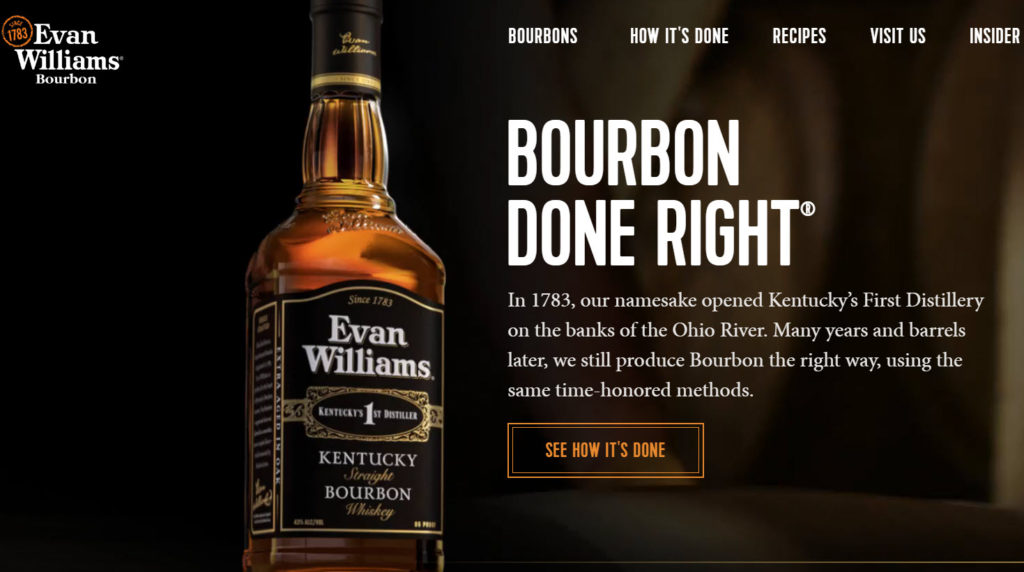
Evan Williams. Bourbon Done Right.

The construct “done right” has been used in taglines in every product category since modern marketing began.  It’s so overused it has lost all marketing flavor. Plus, it presumes there are lots of bourbons done wrong. In addition to using a commodity tagline, “done right” is hard to prove. With a cursory look at the Evan Williams website, the only proof laid out to support the claim is aged in charred oak barrels. And aged for 4 years. Kentucky’s first bourbon doesn’t directly support the claim, though it’s a proof (of something). 

I’m sure Evan Williams is a wonderful product. It deserves a wonderful position in the minds and mouths of consumers. Letting a 32 year old copywriter, who probably drinks kombucha, write your tagline is a mistake. (At least that’s what this one feels like to me.)

Find your proof. Find your claim. Then find your distinction.

Peace.


Brand Strategy Is Business Strategy

I spend most of my waking business hours talking about brand strategy. A topic so obfuscated and buried in marko-babble no one really understands it. It’s tough going. 

The fact is, brand strategy is business strategy. Simplified. And packaged to be easily undertstood.  It’s business strategy boiled down, memorable and shareable.  One of the drivers of a good brand strategy is that is can be activated by everyone in the company. A good brand strategy in the hands of the receptionist or delivery driver or CEO is one that empowers business-building decisions.   

If you work at a company where you don’t want anyone else to know how to make business advancing decisions, because you are fearful they’ll make mistakes, you don’t need a brand strategy. You need Xanax and blood pressure meds. But of you want your employees and as a result, customers and influencers, to understand why you are a better company than the competition, thanks to meaningful product and operating values, then you do want a brand strategy. Because it’s good for business.

Imagine a retail package goods brand that changes its packaging every day. That’s kind of what happens to companies that operate sans brand strategy – AKA “an organizing principle for product, experience and messaging.”

Peace.


Free Day Of Planning.

I was talking to a brand planner at a big agency in NYC a while back and offered him a “free day of planning,” a way to introduce my skillset. The hope was to pick up some additional work.  His response, and I paraphrase, was “What can anyone learn about a brand in one day?” His firm digs very deep and he couldn’t see any one turning up any value in a single day.  Looking back, I find it hard to disagree with him. Though rules are made to be broken. And if a planner can uncover a key insight in a day, imagine what s/he can uncover in a week.

Recently, I offered some folks a free day of planning and it worked out just fine. It was a small but complicated business and the stakeholders found it very hard to explain their model in a few words, especially to potential investors. So they explained in paragraphs. Long paragraphs. They agreed they needed focus and a boiling down of their value proposition.

When I started the clock, I interviewed one of the stakeholders for about an hour and a half. On another day, I interviewed the second stakeholder for an hour and a half. I also interviewed a key software vendor of theirs, someone with hundreds of hours on the street – so as to get an unabashed view of the business. About half an hour. Then I cleaned up all my notes, I’m a horrible typist. Half hour.

Following a review of some competitor websites, another hour, I slept on it. These efforts took place over the course of a week or so, due to others calendars.

When time to begin planning, I read all my notes and started to circle any activities, stories or evidence of value. I call this proof of value. As clusters of value became clear I broke out the colored highlighters. Add two more hours.

Then I slept on in. Early one morning I woke up with an idea. An idea that was the beginning of the brand claim. I can’t count sleeping hours, so this was a freebie.

Over the next day or so I began to craft a few slides of a PPT presentation while massaging the brand claim. The proof planks, organized while doing the value clusters, in the earlier session already existed.  All totaled about an hour and a half to put the PPT together. Total time was 8.5 hours. A day of planning according to the clock.

This piece of pro bono work was strong. The clients were effusive in their praise and thanks.  I never wrote a brand brief — a no-no — but time did not allow for it.

Had I the 3-4 weeks typically needed to do this work it may have been different, certainly more nuanced. And deeper. But is was a job well done. And a brand strategy well received.

Who said Rome wasn’t built in a day? Peace.