Home Blog Page 29

Brand Strategy Targeting.
0

Brand strategy should speak to all targets. And, in a perfect world, all people.  Once we segregate a target and prioritize sub-targets (for maximization) we are moving beyond branding. Segmentation goes counter to brand craft. Segmentation is an important function but it’s a marketing function.

Let’s start at the beginning. When creating a brand strategy, the planner wants to look at all targets that come in contact with the brand. As an example, let’s look at a recent What’s The Idea? engagement for a math tutoring company. The most important target was the parent. The payor. Another important target was anyone who might recommend a tutor, such as a teacher or friend in academia. The tutee (Is that a word?) AKA the student, is also important. And, of course, prospective math tutor employees are important. All these targets have different motivations and care-abouts, albeit math improvement is an ultimate goal.   

To make it more complicated, it’s possible to further parse the parent target. That is, are they up-scale moms and dads? Price-conscious?  Professional or blue collar? Is the tutoring remedial or preparatory, for say college testing? All of these things must be factored in. But for proper brand strategy, with everything factored in, the value prop/brand claim must appeal to all. Everyone must be treated as a prospect. A news reporter, without kids, might break a huge story on your brand, while never being part of the target.

Brand strategy isn’t code, it should speak to everyone.

Peace.



Stop Fiddling Nero.

0

I’ve worked on hundreds of brands throughout the years but the one that probably taught me the most was AT&T. I started out schlepping ads back and forth to Bridgewater, NJ is a big black portfolio case. And I left the business a brand strategist. 

My years working on multiple AT&T lines of business — from retail phone stores, early email services, business long distance, technology (microchips, central office switches, PBXs, video), data lines and more — taught me about the company and its culture. And it taught me brute force marketing. Not all AT&T companies were equal but the brand was strong, well-managed and at the very top, well led.

Today the newspapers refer to AT&T as a wireless company.

The strategist in me would say AT&T is not a wireless company. It’s a telecommunications company. And its announcement to spin off the media properties, formerly Time Warner, is a welcome one.

At its best AT&T is a business business. Not a creative business. People invent stuff there. They are in the telemetry business. And this world and the future are moving that way. Some of us refer to AT&T as in the plumbing business. The pipes, switches and receiver business. It is. And without going too Sci-Fi on you, that business will take all of the company’s energy and efforts to own.

Bring back Bell Labs. Create the future. Leave the sitcoms and romcoms to someone else. Stop fiddling Nero. The planet needs you.

Peace.


A Tale of Three Strategies.

0

A number of years ago, I was involved in a new business pitch for a big piece of healthcare business in NY. I had a knock down drag out fight with one of the ad agencies principles about whether or not to keep the existing (previous agency’s) tagline. I was yeah, the principle was nay. He finally threw in the towel. We suggested keeping that tagline which was “setting new standards in healthcare.”

The brand strategy claim I developed for the health system was “a systematized approach to improving healthcare.” Eyes on the system. You can see how close setting new standards is to a systematized approach.

Fast forward 15 years and that same health system hired a brand consultant to assist in a name change. The brand claim they came up with was “Providing transformative leadership driving the future.” A first pass you’d think it was a Google translation of the previous efforts. A repurpose. But on closer inspection, it was a bit of a pander to senior management. Making the health system leaders the heroes, rather than the system itself.  Words and emphases matter. Especially in strategy.   

Tomato, to-mah-toe?  I don’t think so.

Peace.


Localize It!

0

This week I’ve been thinking about a trend which I’ve yet to name in any meme-able way. When Thomas Friedman wrote that the world is flat, one of the things he was referring to was the fact that the internet and social media have made information sharing around the globe instantaneous. And while not everyone can afford an airline ticket, most people are 12-14 hours by plane to any country they would like to visit. When I am using micro aggressions against xenophobes I like to say, “In 8,000 years, we’ll all be the one skin color anyway.” My way of saying the earth is flat and getting flatter.

But wait!

A contradicting point of view, one being brought on by global warming, viruses, sciences and demographers, suggests we may need less travel. And definitely need to reduce emissions caused by global transport of goods. Here in Asheville, we are very big on local sourcing of food. Hopefully, local sourcing of clothing and everyday essential isn’t far away. If we can create little micro or semi-micro manufacturing schemes to feed the needs of local consumers, and do it eco-efficiently, we’ll reduce emissions and stop carbonizing the planet.

The flattening of the earth made imports and exports viable. Now we need to retrench. To quote a great Rasta Peter Tosh, we need to Localize It.

Peace.  


Is-Does In The House.

0

Every once-in-a-while when reviewing Google Analytics I come across one of my blog posts someone clicked on…and I like to read it just to see where my head was at. 

In one such, I uncovered this descriptor sentence “I run an evidence-based brand planning shop.” Over the years, there have been many ways I described What’s The Idea? but this may be one of the best. From an inside baseball standpoint, it points to my claim and proof framework, a unique differentiator. And while claim and proof are not overly complicated words they do require a bit of explanation.  

The words “brand planning shop” don’t say brand strategy but imply it. And, of course, “evidence-based” centers the narrative around science, not marketing ephemera. Not marko-babble.

I need to start using this meme-able phrase in my self-marketing more. When I speak about a brand Is-Does, what a brand Is and what a brand Does, evidence-based brand planning shop gets me close.

Peace.


Search and Stick-to-itiveness.

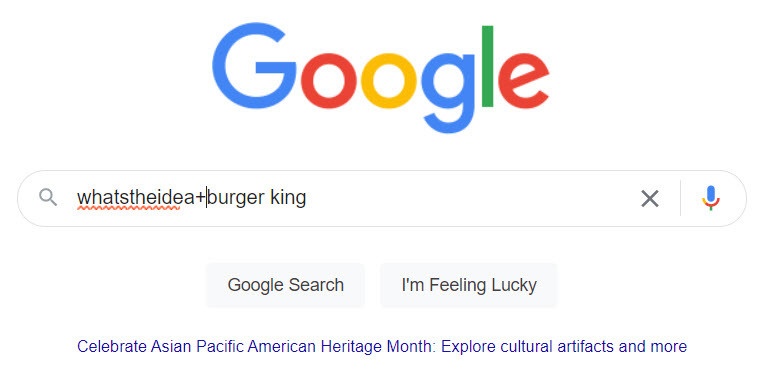
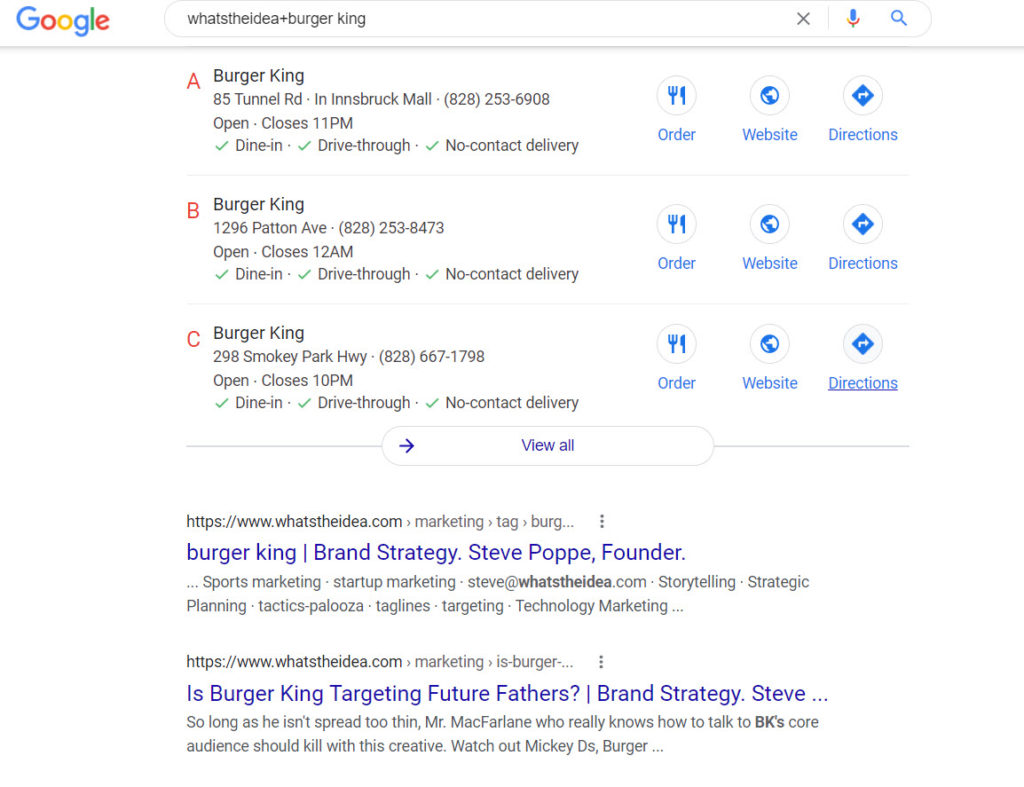
Every morning I try to blog about branding. To date I have somewhere north of 2850 posts. One of the tricks I use to build make blog more visible and build followers is to index each post with my consultancy brand What’s The Idea?  In search terms that means I tag whatstheidea, one word, to every blog — along with whatever else I happen to be writing about.  My intent is to be able to tell people to Google whatstheidea and another word or brand using the plus sign (e.g., whatstheidea+burger king) and they will be one click away from my writings and thoughts. 

It worked for a few years then as Google kept changing the algorithms my results were sent way beneath the fold. I mean waaaay beneath.

Well, it looks like I may be back. Thanks to the latest Google algorithm, some secure server and WordPress magic by my hosting company (Unreal Web Marketing) and a lot of stick-to-itiveness, my years of indexing work has not been for naught.

It’s fun when plans work out.

Peace.


Dunkin’ Cover. (As in, duck and cover.)

0

The wifus loves donuts.  Her favorite is Dunkin’ Donuts Vanilla Crème. On Mother’s Day, a lil bit of powdered sugar still on her lips, she happened to mention that the donuts used to be better. Apparently, the vanilla filling used to extend right to the very end of the donut and now it takes a bite to get there. As a kid who was coaxed to go to church with a jelly donut, I appreciate her point. A donut bite without filling is a lost opportunity. A branding problem.

Since the customer is always right, why did Dunkin’ (they officially dropped the word Donuts from the brand) decide to lighten the filling load? There might be an assortment of reasons: new filling extrusion machines, reduce sugar content for health reasons, save a few pennies, the list goes on. But if one donut lover noticed, you can bet thousands of donut lovers noticed. And of those thousands, how many consciously or subconsciously have decided to try another donut shop – perhaps a craft donut shop — or even another morning confection altogether?

When a butterfly flaps her wings….

When you have craving brands and you alter the recipe or the proportion, it has an effect. There had better be a very good reason for doing it. It gets noticed.

Peace.


Subtract.

0

Leidy Klotz recently wrote a book titled Subtract which I heard about yesterday on NPR during a Mother’s Day drive.  The thesis of the book us that we over-encumber ideas and strategies and, yes, our lives by continuously adding extraneous things.  Think hoarding. Mr. Klotz quoted Lao Tzu to make his point:

“To attain knowledge, add things every day. To attain wisdom, subtract things every day.” Lao Tzu, Quotations, Wisdom.

Brand planning, at least for master brand endeavors, must follow the same advice. We begin by adding knowledge. And that requires lots of discovery. One takes in information, data, behavioral observation, culture and language and hoards it all up. Enough information to make one’s head spin. But then it’s wisdom time. Time to subtract. Time to create hierarchies of import.

Only after subtracting the less important, can powerful ideas and strategy emerge. This is the heavy lifting in brand planning. It’s the story of the sinking boat, when things must be thrown overboard to keep afloat. (Too dramatic?)

In my brand presentation I have a cautionary slide on the “Fruit Cocktail Effect.” When you have too many ingredients, you create a sugary mess.

Subtract is the essence of good brand planning.   As Robert Hunter wrote and Jerry Garcia sang “Hello baby, I’m gone good bye.”

Peace.


Made for People Strategy.

0

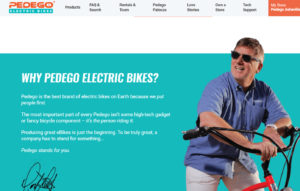
I came across a website yesterday for an electronic bicycle business opening a retail store in Asheville, NC. I’m sure the products are great but I didn’t that from the website write-up. Here’s an open letter form the CEO:

Pedego is the best brand of electric bikes on Earth because we put people first.

The most important part of every Pedego isn’t some high-tech gadget or fancy bicycle component – it’s the person riding it.

Producing great eBikes is just the beginning. To be truly great, a company has to stand for something…

Pedego stands for you.

Don DiCostanzo

This claim is the most-used brand position in the history of commerce. And to be honest, there’s nothing wrong with putting the customer first; I’ve written a number of strategies around ergonomics, for instance. But if I’ve said it once I’ve said it a thousand times, don’t make a claim and let it sit there. Prove it. Provide evidence. Be the claim. Live the claim.

When Nfinity sneakers says their cheer shoes are made for women, they show an engineering drawing of the unique weight distribution radiating down the leg from womens’ hip structures. And then there show the different shoe configuration and weight bearing areas. This is claim and proof.

Mr. DiConstanza, may make bikes that put people first (hate those dog bikes…hee hee), but he needs to build a support case. And he needs to pound it home.

Words matter. Especially in selling. Be what you say you are and share it.

Peace.


Action Vs. Purchase.

0

Yesterday’s post referred to a Neil Parker article in Inc. Magazine, a thought piece on brand as verb.  As much as I agree with Neil’s points, one did hit a sour note for me. He wrote “Ask yourself how your brand can create moments that compel people to contribute rather than persuading them to purchase.”  

I am old-school, but for me all actions must be about moving a customer closer to sale. Marketers and brand builders are in the business of selling not “compelling people to contribute.” Commenting on a website or issue-related actions are secondary to sales — at least for me.  They are good-to-haves and it will happen organically, but they are not the main job of the marketing dept. There are other departments for that. Corporate responsibility, for one. Public relations for another.

Lots of smart advertising, marketing and branding people out there agree “doing” is better than “feeling.” I’m down. But actions that don’t ultimately contribute to sales eat up oxygen. Be careful.

Peace.