Home Blog Page 27

Brand Planks Explained.

0

My brand strategy framework presentation to prospects, contains an example of a strategy for a commercial maintenance company. An excellent company in a tough, price-driven category.

The three brand planks supporting the brand claim are: fast, fastidious and preemptive. Taken together, these three values – top customer care-abouts and brand good-ats – are drivers of business success. If customers believe this company is faster to resolve problems, pays more attention to cleaning and maintenance detail, and offers insights about potential problems before they occur, the company can charge more money and gain market share.

Here’s the problem. If the was to do an ad saying “we are fast.” It’s a comes off as a commodity claim. If they do an ad that says they provide quality cleaning, again commodity claim. And an ad talking about preemptive, well, it’s an unexpected value and needs explanation.

Let’s deal with Fast. This commodity claim can come with baggage. Fast sometimes implies sloppy. By paring fast with fastidious, we overcome sloppy. But to really seed the idea of fast with customers, we need to prove it. Productize it. Build a response mechanism into it so everyone knows the speed of delivery.  For instance, every customer calls to a service line generates a response in 15 minutes guaranteed. And for major issues, they guarantee a person on premise in 45 minutes. Guaranteed. Productized.     

Words are important. Fastidious is not quality. It’s ADD quality. That’s how this company has to hire. That’s how this company has to reward employees.  That’s how this company has to behave. And mostly, it does.  Yes, fastidious is a word, but it’s also a product and operational strategy. And as I said, it improves the take-away on fast?

Lastly, there is Preemptive.  This one’s the real kicker. Most commercial maintenance companies make money by completing tasks efficiently. To do so, they discourage employees from going beyond what they’re contractually obligated to do. My client does things differently; they keep their eyes open.  If they see a potential problem or anticipate a problem, they report it. This often solves issues before they cost the client money. A copywriter might spin the phrase “We treat your business like our business.” Don’t believe it. In the commercial maintenance space customers haven’t heard the word preemptive. It’s different language. And it can be operationalized. Maybe even productized. A history list of disasters avoided on the website maybe.

Take the three planks together, not individually, and you begin to see the power of the framework. When all three actively support the brand claim you have brand strategy.

To learn the brand claim that ties this company’s strategy together write Steve at WhatsTheIdea.

Peace.


Teaching Less and Learn More.

0

I was talking to a client last week and something quite smart came out of my mouth. Unplanned. I like binary things — like “there are two kinds of women in the world, those who eat a sandwich with one hand and those who eat with two.” Don’t ask. Anyway, I was remarking to a this talented client who had lots of irons and revenue streams in the fire that in her line of work you were either “teaching” or “learning.”  I surmised she spent about 85% of her time teaching (in the hope of picking up consulting and speaking gigs) and 15% learning or getting smarter in her craft. I for one can empathize. Give it away in the hopes of getting paid-work down the line.

I suggested she should flip the model or at least even it up at 50/50.

People who constantly teach and don’t learn become pedants. And they’re not a lot of fun to be around. Teachers need to refresh so they can be fresh. And that requires listening. And positing. And debating.

The best part of being a brand planner is the learning. We open the faucet and fill up the stock pot. Only when the pot is full do we turn on the heat and start the boil down.

If you find yourself teaching to much in your line of work, do something about it. You need to up the ante on learning.

Peace.


Copywriting? Creative Writing? Or Writing?

0

Writing is a core competence in marketing. And copywriting an even higher-level competence. A most powerful one. (Albeit there’s no Pulitzer Prize awarded. Hee hee.) Yet, one of the flaws of copywriting — and it’s a big flaw — is writers are often not well-informed about the products under their care. They may know a handful of key selling points but have few, if any, backstories or history about the product. What results is nicely written prose but very little of substantive value. 

It’s almost writing by numbers.

There’s an old axiom in advertising “If you don’t have something to say, sing it.” And that is what most copywriting is today. Sing songy assemblages of words that do little to convince. And they don’t convince because most ads aren’t built using a brand claim, or a cascade of proof to build a case for purchase. An ethnographer would say today copywriters live in copy bullpens, never setting foot in the product or consumer room.

Copywriters aren’t given enough time to adequately understand their products and services. They’re on the clock and unprepared. It’s not their fault they lack product training and understanding, that’s the fault of brand managers. 

Creative writing is what they do. Without proper product understanding it can’t even be considered creative.

Peace.  

PS.  There are a hundred of so brilliant copywriters out there, don’t get me wrong. But thousands and thousands of songsters.


An Example of Marko-babble.

0

I often use the term marko-babble to describe some of the effluvia being shared on the web about brand craft. Or marketing craft. It’s my mission to get rid of mark-babble. 

At a panel discussion the other day, I was close to nauseous by the constant use of the word “authentic.” Rather than babble about marko-babble I wanted to cite some content that actually fits the bill.  The brand services company that posted these words will remain nameless.  And I’ve Googled the entire sentences and the posting company name did not come up, so I’m in the clear.     

Let it rain:

Brand
We build modern, digital-first brands designed to lead through market change and create long-term value for shareholders, customers, employees, and wider society.

Culture
We build purpose-driven cultures that drive employee behaviour and accelerate business growth.

Experience
We develop powerful, multi-channel creative communications, and intelligent, user-centric digital solutions designed to create lasting impact.

So, do you have a good idea now of what these girls and boys do? Specifically? Uh…they build, build and develop.

As famous Broadway producer David Belasco once said “If you can’t write your idea on the back of my calling card, you don’t have a clear idea.”

Peace.


Digital First Brands.

0

In my travels through the ether I’ve read more than once the proclamation such-and-such is “a digital-first brand.” I have to admit, I’m not quite sure what that means.  If digital is first, what is it second? A brick and mortar business? A print business? I know AI is a growing these days — is that what a digital first brand is?

If this was 1999, I could see calling yourself a digital first brand. That might be clearer. But today, everything is digitized and online.

Being digital today is the price of doing business. If usability is poor, you fail. If online visibility is poor, you fail. If findability is poor, you fail.

It’s simple really. Brands need to be something and mean something. Those spending time attempting to be trendy or common are lost.

Peace.


Click-aholics.

0

Noah Brier wrote in the WITI newsletter today:

Loyalty is about nurturing behavior that defaults in a business’s direction.

Noah knows marketing. (Noah knows.) “Default” and “in a business’s direction” are spot on.  In a presentation on a digital comms planning tool “Twitch Point Planning,” I suggest “moving customers closer to a sale.”  Noah and I are intentional in being noncommittal. Non-absolutist.

Digital generation marketers think nirvana is going from an unknown brand to click-to-buy in a matter of keystrokes. That would be cool. (And it can be done. See a picture of a pair of unknown sunglasses on Kim Kardashian and BAM! Click to buy.) The belief that that steps-to-a-sale (Awareness-Interest-Desire-Action) can be collapsed into a click or two is a digital marketers’ dream. And fantasy. Frankly, it’s a cancer that metastasizes daily.  

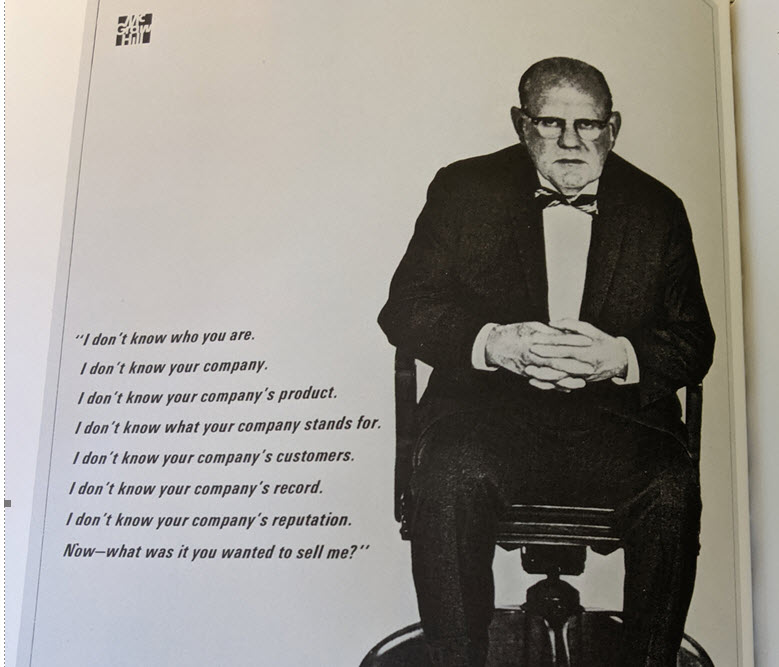
A very famous McGraw-Hill ad states: 

“I don’t know who you are.
I don’t know your company.
I don’t know your company’s product.
I don’t know what your company stands for.
I don’t know your company’s customers.
I don’t know your company’s record.
I don’t know your company’s reputation.
Now – what was it you wanted to sell me?

Selling takes work. Building brand affinity and loyalty takes work. And it’s fragile. Back to Noah. If we don’t take a long-term approach to nurturing, if we don’t understand that loyalty is simply a default until something shinier comes along, we’re kidding ourselves.

One click sales is not branding. No foreplay. No demonstration of caring or consumer love. Just a click. A sale. Too many digital entrepreneurs are click-aholics. Clicks are not strategy.

Play the long game. The humble game. You have time.

Peace.


Victoria’s Secret Needs To De-Brand Before It Rebrands.

0

Here’s a question for my branding friends. Before you can rebrand, must you de-brand? I say that because I’ve been reading today in The NY Times business section about Victoria Secret’s efforts to redefine what the brand is — so as to make it more inclusive and more women-centric. Or maybe even more “we” centric, using the more nonbinary term.

Sexy, according to the article, has long been tailored to the male point of view.  The retail experience, the marketing experience has been using a dated prototype of the so-called perfect body. Well, Victoria Secret’s market share (in women’s underwear) has dropped 11 points since 2015 and that’s more than a clue. Broadening their market is the future. Redefining sexy to be more functional and stylish is the goal.

(When women in the 80s started shaving their heads during the punk rock era on the lower east side of Manhattan, it was a functional decision. It also became stylish.)

So, must Victoria Secret rebrand or de-brand? In this case, I’d go with de-brand.  Provide a mea culpa and an explanation. Do it once. Do it big. Then move on. With a new mission. A new creative approach. And a new motivation. The market will follow.

Not all brands need an interim step before rebrand. Many do.  In today’s world, it’s a thing.

Peace.   


https://www.nytimes.com/2021/06/16/business/victorias-secret-collective-megan-rapinoe.html


Is there democracy in brand strategy?

0

When comparing the new (multiparty) Israeli Parliament with that of the (2 party) United States congress one can see how democracy must use compromise in order to work. If you think it’s hard to make decisions with two parties, imagine ten. When nobody really gets what they want, people are more apt to think harder. And be creative.  

Speaking of democracy, is there room for it in brand strategy? My gut and sharings over the years lean toward “no.” You are either on idea or you are not. And as Marilyn Laurie of AT&T lore has said “You are either making deposits in the brand bank or withdrawals.”

But, if using the What’s The Idea? framework for brand strategy (one claim three proof planks), you really do have room to compromise. Granted, the claim is the claim and that’s pretty binary. However, the proof planks are real brand building blocks and they do provide a level of democracy.

Back in the day, working on AT&T’s business services, the plank for innovation worked against that of competitive price. That is, as attitudes increased that AT&T was an innovator, the competitive prices attitudes sunk. Hence, these different “parties” has to be monitored, metered and planned to maximum effect.

Attitudes beget behavior. Attitudes built through Democracy build brands. Attitudes built through despotism build decay.

Peace.


Smiles and Purpose.

0

I just read a couple of PepsiCo’s strategy statements.  PepsiCo is the $70B master brand for a broad assortment of sugary carbonated drinks and salty snacks, along with some other portfolio products in water, juice, tea and Quaker breakfast foods and snacks.

It’s hard to do strategy for a massive conglomerate of brands. It’s especially hard when most of those brands are convenience store foods and rather unhealthy. But this is America and where there is demand there’s will be supply.

Here is PepsiCo’s stated corporate mission: To create more smile with every sip and bite.

And here is their vision statement: Be the global leader in convenience food and beverage with purpose.

So to sum up the mega billion portfolio, it’s all about smiles and purpose.  Hmm. Where do I start? Try giving that brief to a creative team at BBDO.

As I said, conglomerate company strategy is hard. General Motors has tried to do it using advertising and it never worked. Advertising agency holding companies know better. IPG, WPP, Omnicom never try to explain their value. It’s like herding cats.

Back to Smiles and Purpose. Purpose is something you communicate if you are not known for having purpose…other than, perhaps making money. And Smiles? Well, they are not wrong.  But it’s just hard to own. Smiles are the universal language of enjoyment and as such not very differentiated.

If PepsiCo really wanted to promote purpose, they would pick one. And only one. Planet. Diversity. Equality. But not all. PepsiCo’s mission and vision deserve better. What’s that story about the cobblers children?

Peace.


The Fine Lines of Brand Strategy Consulting.

0

When you are a consultant, you walk a fine line between telling customers and prospects what they are doing wrong while complimenting them on what they’re doing right.  You wouldn’t have a foot in the door were they doing everything right, yes?  But that’s no reason to tell them their baby is ugly.

When a brand consultant, you walk an even finer line when interacting with prospects because you don’t really know the brand. You haven’t done discovery. You haven’t articulated the addressable business problems. You haven’t dug into the customer care-abouts or brand good-ats. Without those lines of reasoning anything you say can and will be shallow. So, you do the shallow spade work. Which often ends with discussions about process, procedures and practices. Not sexy.

People like to talk about themselves and their frames of reference. Brands do too. Trust me, when I do brand discovery it’s fire hose time. But to get to discovery you have to a client to sign on. And even if they open up on a call or two, you can’t make any real judgements until the cake it out of the oven (Alex Bogusky).

This is a conundrum I have yet to crack adequately. So I listen. I overlay some thoughts. I qualify my answers with a plea of brand ignorance. And I hope to build trust.

As I said, a fine line.

Peace.